Showing posts with label genealogy. Show all posts

Friday, 31 January 2025

The Challenge of the SMITH Surname


I guess that everyone has a SMITH somewhere in their family tree, but my maiden name was SMITH, so I have a major stake in the game of SMITH. 

My SMITH family are from Scotland, and of course it is the most common name in Scotland.(1)

Alexander Dunn SMITH was born in Barrachan, Mochrum, Wigtownshire, to Francis SMITH and Agnes YOUNG.(2) He married Helen TURNER (3), and they emigrated to Australia in 1853. (4)

My challenge is definitely his parents. The Kirk Session records for Mochrum are sketchy, and although I have found records of Alexander's older siblings being born in the same place, there is no record of the marriage of Francis SMITH and Agnes YOUNG, and no records of their births/baptisms or deaths/burials. 

These are their children:

  • Mary born 17 October 1809 at Barrachan
  • Jane born 7 May 1811 at Barrachan
  • Agnes born 20 December 1813 at Barrachan
  • James born 15 November 1815 at Barrachan
  • Sarah Cherrie born 10 May 1818 at Barrachan
  • Robert born 15 May 1820 at Barrachan, and
  • Alexander Dun(n) born 3 Oct 1823 at Barrachan.

Apart from the records of the births/baptisms of these children, the first record I can find for Francis SMITH is 14 Sep 1822 when he received 6 shillings distributed from the Poor money by the Kirk. (5) He was a weaver, and I conclude that he was 'of' the Parish as he was receiving this poor relief. He regularly received money from the Kirk until 20 Mar 1824. So far I've not discovered any record of his death, but it must have happened between that date and 26 June 1824, when Agnes YOUNG starts receiving money from the Kirk. Agnes 'seems' to be in the 1841 census, 53 years, living at Barrachan Farm along with Agnes McKOMIR (10 years) and Agnes BROWN (85 years).(6)

So, I wait patiently to see if my challenge of poor people called SMITH, in a place with no records can ever be overcome. I'm more than happy to receive suggestions.

(1) Scottish surnames - Wikipedia

(2) Results for Alexander Smith | Scotland's People - , "National Records of Scotland", [https://www.scotlandspeople.gov.uk/ ScotlandsPeople] Index for ALEXANDER DUNN SMITH, Parents: FRANCIS SMITH and AGNES YOUNG, Gender: M, Birth Date: 3 October 1823, Parish #: 892, Parish: Mochrum, Ref: 20///9; accessed: 31 January 2025

(3) Results for Alexander Smith | Scotland's People - , "National Records of Scotland", [https://www.scotlandspeople.gov.uk/ ScotlandsPeople] Index for ALEXANDER SMITH and ELLEN TURNER, Date: 4 December 1843, Parish #: 892, Parish: Mochrum, Ref: 20///211; accessed: 31 January 2025

(4) Queensland State Archives, Microfilm of passenger list "Agricola: arriving Moreton Bay 26 Feb 1853

(5) Mocrum kirk session Minutes (1826-1847), Poors' accounts (1794-1834), CH2/269/1, CH000200269-00001-00001-.jpg

(6) Results for Agnes Young | Scotland's People, "National Records of Scotland", [https://www.scotlandspeople.gov.uk/ ScotlandsPeople], 1841 Census Index: AGNES YOUNG, Gender: F, Age at Census: 53; Ref: 892/ 7/ 7, Registration District: Mochrum; accessed: 31 January 2025

Sunday, 19 November 2023

Family Food Memories

There are some foods from my childhood that I suspect came down through Dad's side of the family, and were from more of a German influence from Clara, (his adoptive mother, but actual grandmother). 


LatkeFry.JPG
One that we had quite regularly, and is Potato Cakes. These are made from grated potato, mixed with some flour and eggs, and then fried in oil. I have my own version which adds sesame seeds to one side and some grated cheese to the final side. These are very tasty with chutney. These are traditionally called Latkes (or Kartoffelnpuffer), (and seem to be of Jewish origin), but we never called them that.
(Photo by Jonathunder - Own work, CC BY-SA 3.0, https://commons.wikimedia.org/w/index.php?curid=5629332)


Zwieback-1.jpgOn Sundays when we had Roast, we would always make 'baked bread'. You take slices of bread (they can be stale) then put them on a flat tray and dry them out in the oven. I have since found out that this is called Zweiback (German, meaning twice baked).

(Photo by No machine-readable author provided. Rainer Zenz assumed (based on copyright claims). - No machine-readable source provided. Own work assumed (based on copyright claims)., CC BY-SA 3.0, https://commons.wikimedia.org/w/index.php?curid=658529)


Mum would often make Corned Beef with cabbage and White Onion Sauce. I liked the meat but was never a fan of the 'boiled to death' cabbage and Onion Sauce. In the following days, Dad would slice the left-over corned meat and dip it in batter and fry it. Dad called this "Burdekin Fish" which I think was a salute to the huge beef industry around the Burdekin River. For dessert Mum would also make banana and pineapple fritters, which were battered, fried and then sprinkled with sugar.

A special treat for breakfast was always one that Dad prepared. He would get a tank loaf of bread, cut the crusts off, cut it into cubes, then drench with hot milk which had sugar dissolved in it. The taste of this was so heavenly to me, and years later I tried to reproduce it, but my versions were always a sad disappointment as they never tasted like those that Dad made.

Some of my childhood foods came from Mum's Scottish side of the family. One of these, which she called Posset (although the definition of Posset seems different), seems quite peculiar if you think about it. Mum would place an Arnott's Arrowroot biscuit in a bowl, cover it with warm sweet milk, put a saucer over the top and leave it for a while until the biscuit was swollen with the milk. If the milk didn't have sugar on it, then sugar was sprinkled over before eating.

Grandma Anderson was a big proponent of Porridge made from oats, and I think she made it every morning. She had a traditional porridge stick (spurtle) for stirring it. The porridge was sprinkled with brown sugar and milk added before eating.

I complained of a sore throat once when staying at Grandma and Grandpa's and Grandpa made me a 'special' mixture to ease the pain. He took some butter and mixed in some sugar to make a little ball which I then sort of dissolved in my mouth. I can't remember if it actually worked, but it sure tasted great.

Mum was not a particularly good cook, but she did her best. When she first married Dad and they went on their honeymoon at a flat at Kingscliffe, Mum had forgotten to take her recipe book, so Dad cooked a stew.
The happy couple on their honeymoon


At one stage Mum got a new Sunbeam Frypan and it came with a little recipe book which had a recipe for Cabbage Cantonese. This was basically fried onion, add some mince, then shredded cabbage and sprinkle on some soy sauce, then eat with boiled white rice. This was a fairly cheap meal and became a family favourite.

Other regular meals were a dry mince curry, Sausages and veges, desserts were Ice-cream from Evaporated milk & Jelly, or sometimes a boiled pudding. We also had French Toast, crumbed brains, lambs fry & bacon, pea and ham soup made in the pressure cooker, (which Mum was given as a wedding present). 


Mum loved lambs kidneys, but Dad absolutely detested them, so they were only served rarely. One thing that they liked that I detested was tripe. The last time I can remember Mum cooking it was in Melbourne, and I got vomited from the smell. In Melbourne we often had rabbit from the rabbit man. Sunday roast was usually a chicken, but sometimes beef. Mum baked lots of things, but she couldn't get sponge cakes to work. Mum and Dad also really liked tinned soup, and we often had asparagus, tomato, or mushroom Campbell's Soup for lunch.

When we lived in Biggenden, (in 1966), Dad was the Methodist Minister, so we were fairly poor. One of his parishioners must have shot some ducks and gave some to us for a meal. I don't think Mum had cooked it before, but she baked it. We were shocked to find it full of lead pellets! I don't think any of us enjoyed it much, and we certainly never had it again!

The only take-away we ever had was fish and chips, which came wrapped in printed newspaper, and liberally dosed with salt. Dad's favourite to have with them was Potato Scallops, but he would always share one with us kids. Mum loved fresh crab, and Dad would always try to get her some when we had an opportunity for fresh seafood.

Some of Mum's cooking items, which bring back memories are:

The bowl that the Aeroplane Jelly was always made in.

There were a set of 6 different coloured bowls for 'special' desserts

The flour sifter for baking days

There was a matching aluminium sugar bowl to go with this milk jug

The Pyrex casserole dish

Dad hand-turned these wooden egg cups

These plastic canisters were the height of fashion in the late 60's early 70's

These cups (this one and below) actually came from Grandma Anderson. This one was my favourite as whenever we visited my Grandparents, Grandpa would make me a cup of very milky tea with an Arrowroot biscuit (for dunking) before breakfast every day, and mine was in this cup.


Saturday, 11 January 2020

A Fresh Start for the Drover Family

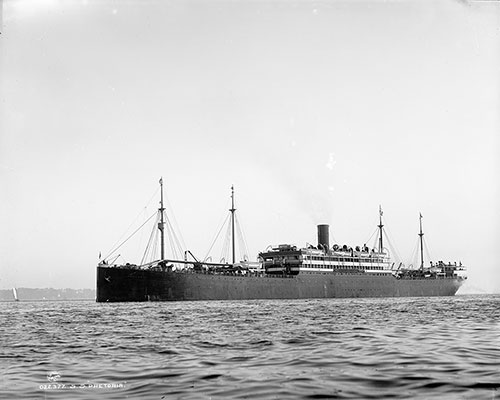
Charlotte Drover was ill and her doctor told her that she needed to get away from the cold wet climate in Edinburgh. He had diagnosed 'false angina.' This prompted William Steedman to pack up his family and they sailed on the "S.S. Pretorian" for Toronto Canada on 28 July 1906. Queenie, (Charlotte's daughter also Charlotte), held up the ship. She said she was late for the train, but the train waited for her, and the ship waited for her to arrive. (I am sure the rest of the family was with her as she was only 4 1/2).

https://www.gjenvick.com/Passengers/Ships/Pretorian-PassengerLists.html

Many other family members had already made the journey and were living in the eastern parts of Canada, so I am sure that was a major reason for chosing it. The family took up residence at 50 Bellview Avenue in Toronto.

50 Bellview Ave, circa 1909

50 Bellview Ave, circa 1987

Queenie went to school, and William (her father) taught music, mainly the violin and cello. A favourite passtime was making snow angels, and Queenie and Gilbert quite enjoyed living in Canada. Unfortunately, the climate in Toronto did not improve the paroxysms in her chest that Charlotte was suffering, and the doctor told her that she needed to be in a warmer country. 

The whole family, William, Charlotte, Fred, Nettie, Gilbert and Queenie headed back to Liverpool England, where they boarded with a Mrs Grant (although the passenger card says that they were living with a Miss Northcroft in Wallington, Berkshire). They had a friend in South Africa and a friend in Australia, and they didn't know which place to go, so they drew it out of a hat! On the 22 September 1910 they boarded the "S.S. Osterly" heading for Brisbane Australia. 

Even though Charlotte was ill she did all the packing in Canada, and left half a house full of furniture. A woman was employed to sell that furniture and send the money, but of course the money never came.


S.S. Osterley

Queenie said the voyage took six weeks and the everyone was amazed by seeing "Halley's Comet".

 
Taken in 1910 (https://commons.wikimedia.org/wiki/File:Halley%27s_Comet_-_May_29_1910.jpg)


The kids on the ship must have had a lovely time, sliding down the bannisters, collecting gum, calling out "The World's come to an end, Mrs McGinty's washed her face", and enjoying cocoa and cheese for supper at night.

On arrival in Brisbane the family took up residence in a house called "Meadowside" on Kelvin Grove Road. This house had been described in an advertisement as being double-story with eight rooms and a splendid position, although subsequent advertisements described 7 rooms and a bathroom. William started advertising for pupils, but he had initially been a part of the orchestra playing at "The Lyceum" for King's Pictures.


"The Brisbane Courier" Mon 6 Mar 1911, p11 http://nla.gov.au/nla.news-article19677062

By 1915 William was advertising for Instrumentalists for the St Andrew's orchestra. William's trade was as a printer, but I can't locate any evidence of him working in that profession, only as a music teacher and having his own orchestra. Aroung 1919 William was able to purchase their own home at 37 Spring Street, South Brisbane, which they named in favour of a special family place in Scotland, "Lasswade".

Charlotte and William lived here until they died, and then the home was taken over by their son, Gilbert and his wife Annie. Despite the warmer, drier weather, Charlotte continued to suffer her 'false angina' and lived to be 75 years old.


They may not have been aware, but they were not the first in the Drover family to come to Australia, although the previous member did not come of his own accord. William's half-great Uncle, also William, was convicted of the murder of his wife and sent to Australia nearly 80 years before. They were also not the last Drover emigrants as another William, William Cuthbertson Drover (Bill) and his wife Dot emigrated to Victoria before 1956 on the "Stratheden".


Footnote: the full transcript of the interview with Queenie is in this blog post.

Thursday, 7 February 2019

Drover Family Heirloom

This lovely black glass milk jug was given to me by my Grandmother, Queenie Anderson, but was brought to Australia from Scotland by her mother Charlotte Drover in 1910.


It has no markings and is probably not worth anything in monetary value, but as the family came from Scotland I love the Scottish decoration of the rose and thistle.


Although the Drover family came to Australia in 1910, arriving on the "SS Osterley" on the 22 September, they came via a rather circuitous route. Charlotte Drover suffered from 'false angina' and was told by her doctors in Edinburgh that she needed to get out of Scotland to get relief. 

Charlotte Drover (nee Sutherland)
On the 28 Jul 1906 the family boarded the "Pretorian" and sailed for Toronto, Canada. I think Canada was chosen as there were many others in the family who previously emigrated there. Unfortunately, Charlotte's condition was no better in Canada, and doctors there told her she needed to go somewhere hot and dry, so they came to Brisbane. I don't know whether her condition was any better in Australia, but she lived to be 75, dying on 29 Oct 1937.